NEW!! BOOK RELEASE!! AVAILABLE
ON AMAZON!!
THE INTELLIGENCE OF LAKES
Hydrological Thresholds and Settlement Archaeology
Authored, illustrated, and featuring original
cartography by Ömer Tanyürek & Whitney Taylor
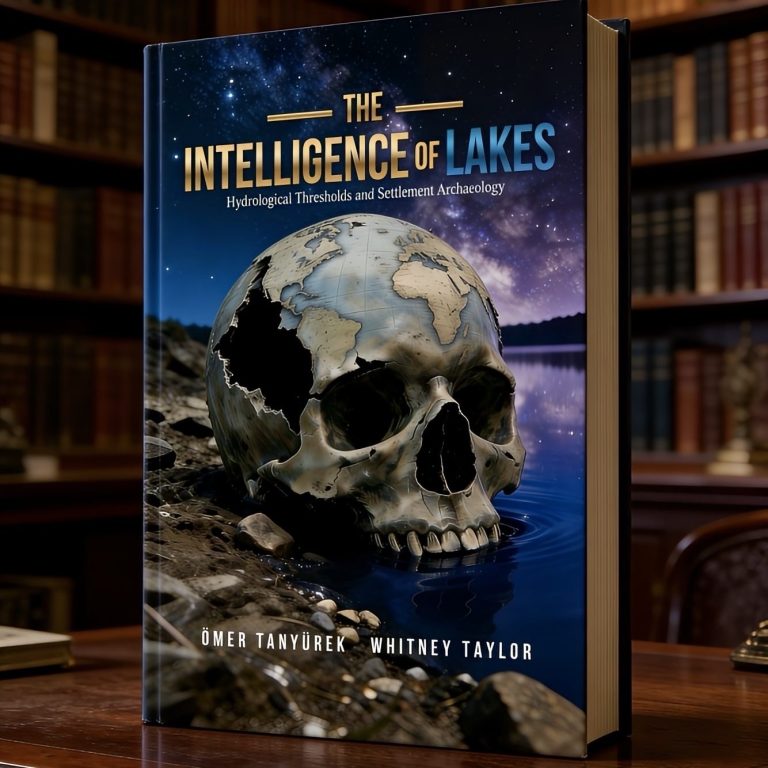
What if the absence of archaeological sites is not evidence of absence—but a failure of perspective?
The Intelligence of Lakes challenges one of the most deeply rooted assumptions in archaeology: that past human settlement can be understood through the static landscapes we see today. Drawing on 13 lake basins across the globe and extending as far back as the Late Pleistocene (~70,000 BP), this work introduces a fundamentally new way of reading human history—through dynamic water systems, shifting shorelines, and hidden landscapes.
At the core of the book lies a groundbreaking theoretical contribution: the Lake Intelligence Framework (LIF). This model redefines lakes as active, structuring forces that shape settlement behavior through five interlinked dimensions—basin morphology, hydrological thresholds, spatial distribution logic, resource accessibility networks, and cultural–symbolic encoding. Together, these components form a powerful analytical system capable of predicting where past human activity should exist—even when it is no longer visible.
This is not a descriptive study. It is a predictive, model-driven approach grounded in high-resolution GIS-based cartographic analysis. The book presents a series of original geospatial reconstructions that go beyond conventional mapping. By integrating paleoshoreline modeling, bathymetric data, and environmental dynamics, it reveals entire settlement landscapes that have been submerged, buried, or overlooked. These maps are not illustrations—they are arguments.
Across diverse case studies—from Lake Van to Issyk-Kul, from Titicaca to Sevan—the book demonstrates that human continuity in lake basins does not depend on fixed locations, but on adaptive spatial strategies. Settlements shift, reorganize, and persist within moving environmental thresholds. What appears as fragmentation in the archaeological record emerges instead as structured, intelligible patterns when viewed through a dynamic framework.
The implications are profound.
This work proposes that a significant portion of human settlement history remains hidden—not lost, but misinterpreted. It calls for a transformation of settlement archaeology from a site-based discipline into a landscape-based, process-driven science.
Combining archaeology, geomorphology, hydrology, and advanced GIS modeling, The Intelligence of Lakes offers a new theoretical and methodological foundation for understanding how humans have interacted with complex environments over deep time.
This book is essential reading for archaeologists, geographers, historians, and researchers seeking to rethink the relationship between water, landscape, and human intelligence.
Explore the publications, services, and products offered by Unearthed Legacy Foundation—where every purchase helps support its worldwide mission.
Book Section - Coming Soon
At Unearthed Legacy Foundation, we invite you to explore our curated selection of archaeological and natural science volumes. Our publications and educational materials are designed to deepen understanding of human history, past environments, and the evolving relationship between people and the natural world. From in-depth research to engaging activity guides, each resource aims to spark curiosity and support meaningful learning. Whether you're an educator, researcher, or lifelong learner, our materials offer valuable insights into the connections that shape our world.